

In the world of high-precision motion control, standard motors often fail when removed from the Earth’s atmosphere. Whether in semiconductor fabrication, space exploration, or scientific research, specialized vacuum stepper motors are required to perform precise movements where air is absent.
Understanding how these motors work requires looking beyond basic electromagnetism and into the materials science and thermal management necessary for "airless" operation.
1. The Core Principle: Electromagnetic Stepping
At its heart, a vacuum stepper motor operates on the same fundamental principle as a standard stepper motor. It is a brushless DC motor that divides a full rotation into a number of equal "steps."
The Stator: Contains multiple coils (windings) that, when energized, create an electromagnetic field.
The Rotor: Usually a permanent magnet or a soft iron core with teeth.
The Movement: By energizing the stator coils in a specific sequence, the magnetic field "pulls" the rotor, causing it to align with the field in incremental steps.
2. Overcoming the Vacuum Challenge
While the electromagnetic theory remains the same, a standard motor would quickly seize or fail in a vacuum. Vacuum stepper motors are engineered to overcome three primary hurdles:
A. Outgassing and Material Integrity
In a vacuum, materials like standard plastics, glues, and greases undergo outgassing—a process where trapped gasses are released into the environment. This can contaminate sensitive equipment (like telescope lenses or silicon wafers).
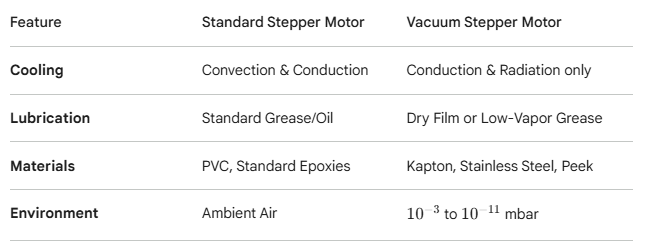
The Solution: Vacuum motors use specialized high-temperature polymers (like Polyimide/Kapton) for wire insulation and stainless steel or aerospace-grade alloys for the housing.
B. Thermal Management (The Absence of Convection)
On Earth, motors stay cool because air moves around them, carrying away heat (convection). In a vacuum, there is no air. Heat can only escape through conduction (through the motor mounts) or radiation.
The Solution: These motors are built with high-efficiency windings to minimize heat generation. They are often "heat-sunk" to a metal plate that conducts thermal energy away from the motor body.
C. Specialized Lubrication
Standard oils and greases evaporate in a vacuum, leading to metal-on-metal friction and eventual welding of the bearings.
The Solution: Vacuum stepper motors utilize solid lubricants (such as molybdenum disulfide or tungsten disulfide) or specialized low-vapor-pressure synthetic fluids that do not evaporate under low pressure.
3. Key Design Modifications
To ensure long-term reliability in environments reaching pressures as low as $10^{-7}$ to $10^{-10}$ hPa (Ultra-High Vacuum), manufacturers implement several critical design changes:
Vented Holes: Small channels are drilled into screw holes and internal cavities. This prevents "virtual leaks," where pockets of air trapped during assembly slowly leak out over weeks, ruining the vacuum levels of the chamber.
Encapsulated Coils: Windings are often vacuum-impregnated with specialized resins to ensure no air bubbles are trapped within the motor's electrical heart.
High-Grade Bearings: Bearings are often made of ceramic or dry-lubricated stainless steel to prevent cold-welding.
4. Summary of Technical Specifications
Conclusion
The vacuum stepper motor is a triumph of specialized engineering. By stripping away materials that outgas and re-engineering how heat and friction are managed, these motors allow for nanometer-scale precision in the most inhospitable environments known to science. Whether it is moving a sample inside an electron microscope or positioning a satellite component, the vacuum stepper motor provides the "steps" necessary for modern technological progress.
102, Tianji Building, Xinggang Tongchuang Hui, No. 6099 Bao'an Avenue, Xinhe Community, Fuhai Street, Bao'an District, Shenzhen, China


Copyright @2024 Zhonggu Weike (Shenzhen) Power Technology Co.Ltd., All Rights Reserved.
Sitemap
/ Blog
/ Xml
/ Privacy Policy
 Network Supported